
Introduction
Unmanned Aerial Vehicles (UAVs) rely heavily on GPS for positioning, navigation and autonomous flight. However, many real-world environments do not offer reliable satellite coverage. Dense urban areas, indoor facilities, forests, underground structures and contested regions can severely disrupt GPS signals. In these conditions, UAVs must depend on alternative navigation methods to maintain stability, situational awareness and mission reliability.
Modern GPS-denied navigation UAV systems are designed to operate independently of satellite signals. By combining onboard sensors, intelligent algorithms and real-time decision-making, UAVs can safely navigate complex and unknown environments. These systems form the foundation of advanced drone operations across industrial, commercial and defense applications.
Why GPS Fails for UAVs
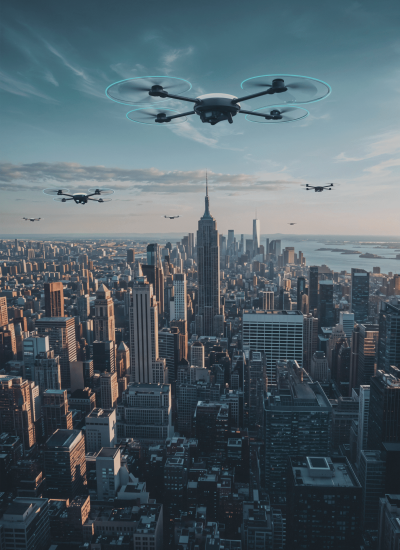
GPS performance depends on uninterrupted communication with satellites, which is not always possible. In cities, buildings reflect and block signals, leading to positioning errors. Indoor environments and tunnels eliminate satellite access entirely. In security-sensitive regions, GPS signals may be intentionally jammed or spoofed, making traditional navigation unreliable.
When UAVs operate close to the ground or in unfamiliar environments, limited sensor visibility further complicates navigation. Without dependable positioning data, flight safety and efficiency are at risk. These challenges make navigation in GPS-denied environments a critical capability rather than an optional feature.
Core Techniques for GPS-Denied Navigation
Reliable navigation without GPS depends on combining sensing, perception, and intelligent control methods.
Sensor Fusion UAV Navigation
Sensor fusion is a method of integrating the output of several onboard sensors including IMUs, cameras, LiDAR and radar. IMUs offer constant motion information but are prone to temporal drift. LiDAR and radar provide distance measurements and obstacles. The combination of these sensor signals enables UAVs to have proper position and orientation estimates, even in the absence of GPS, and creates more resilient and stable flight.
Vision-Based Navigation UAV Systems
Vision-based navigation is based on onboard cameras and computer vision algorithms to cognize the environment. UAVs tracks visual objects, landmarks, and obstacles to determine movement and maneuver their flight. Deep learning models also enhance object detection and scene perception, and this method is particularly useful in indoor and high-density urban situations.
SLAM for Drones
Simultaneous Localization and Mapping (SLAM) allow UAVs to build a map of an unknown environment while tracking their own position within it. As the drone moves, it continuously updates both the map and its location. Visual and LiDAR-based SLAM are widely used for autonomous exploration and path planning. Although SLAM is computationally demanding, it remains a core component of GPS-denied navigation systems.
Cooperative and Multi-UAV Navigation
Cooperative navigation improves reliability by allowing multiple UAVs to work together. Aerial drones with wider viewpoints can collect global environmental data, while low-altitude drones focus on local navigation and obstacle avoidance. Technologies like ultra-wideband (UWB) ranging enable accurate relative positioning between UAVs, reducing dependence on GPS and improving coordination in real time.
AI-Driven UAV Navigation Techniques
Artificial intelligence is important in ensuring that UAV navigation is more adaptive. Reinforcement learning enables the UAVs to adapt navigation strategies by self-interacting with the environment, while complex sensor data are processed by the deep models of learning which include images and point clouds. These artificial intelligence solutions assist UAVs to react efficiently to moving and unpredictable GPS-denied situations.
Software Challenges and Practical Solutions
GPS-denied navigation places heavy demands on onboard software. Large volume of sensor data must be processed in real time by UAVs to avoid being thrown off and hitting obstacles. Filtering, data fusion and synchronization must occur efficiently to prevent delays and errors.
Safe flight paths are generated by the use of advanced path-planning algorithms, based on live environmental data. In order to handle the computational load, there are systems that spread the task among multiple UAVs or use edge and cloud-based processing. Much simulation and controlled testing is essential in order to validate performance prior to deployment in the real field.
Applications of GPS-Denied Navigation UAV Systems
GPS-denied navigation is widely used across many industries. In industrial inspection, UAVs operate inside factories, warehouses, and power plants where GPS coverage is weak or nonexistent. Urban delivery and logistics systems rely on vision-based navigation and sensor fusion to move safely through crowded environments. Emergency response, search-and-rescue, and security operations also depend heavily on reliable navigation without GPS.
These use cases highlight the growing need for robust, independent UAV navigation systems that can function beyond satellite-based technologies.
Future Trends
The future of GPS-denied navigation is evolving due to the ever-changing development of AI, collaborative systems of UAVs, and lightweight onboard computers. Swarms of UAVs will become more efficient and resilient to faults due to perception and navigation data exchange. Large-scale, real-world deployment will also be assisted with energy-efficient algorithms and hybrid onboard-cloud architectures.
Conclusion
GPS-denied navigation UAV systems are a critical enabler of modern autonomous flight. Through sensor fusion UAV navigation, SLAM for drones, vision-based navigation UAV systems and AI-driven navigation techniques, UAVs can operate safely and reliably in environments where GPS is unavailable. As these technologies mature, they will continue to expand the capabilities and applications of autonomous UAV systems across industries.