
Introduction
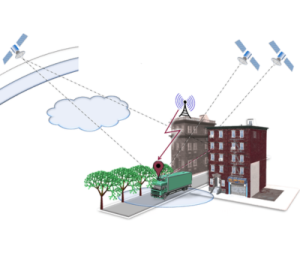
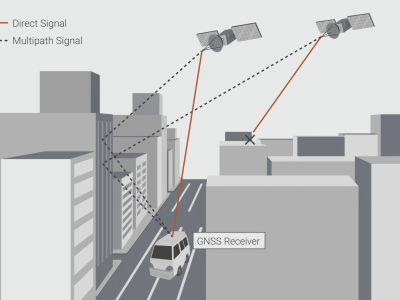
Imagine an autonomous car driving along a dense urban canyon. Satellite signals bounce off glass building facades, making GNSS lose accuracy near intersections. When this happens, relying on one sensor alone can mean the difference between safe navigation and system failure. Modern autonomous vehicles face a fundamental challenge: no single sensor can reliably handle every environment. GNSS struggles in tunnels and urban canyons, inertial sensors drift over time, and cameras fail in poor lighting or bad weather. This is where GNSS INS integration comes in, combining Global Navigation Satellite Systems and Inertial Navigation Systems into a powerful positioning solution that addresses the weaknesses of each sensor individually.
Why Single Sensors Fail in Autonomous Navigation Systems
Inertial Navigation Systems provide continuous, high-frequency positioning updates independent of external signals. However, IMUs inherently accumulate errors over time due to sensor biases and noise, rendering standalone inertial navigation impractical for prolonged operations. The physics behind this limitation is straightforward. INS calculates position by integrating acceleration measurements twice. Any small bias in the accelerometer or gyroscope compounds rapidly, causing position estimates to drift by hundreds of meters within minutes without external correction.
Sensor Fusion Architectures for Autonomous Vehicles
Loosely Coupled Integration
In loosely coupled systems, each sensor processes its data independently before sharing position estimates. This modular design makes system design and debugging easier; in case of failure of a sensor, the other sensors will keep running on their own. It is, however, disadvantageous to accuracy as the raw measurements are not exchanged. Loosely coupled mode of GNSS INS incorporation is unable to utilize the measurements of individual satellites, and therefore, this leaves important information that can enhance accuracy.
Tightly Coupled Integration
Tightly coupled systems fuse raw sensor measurements at the earliest possible stage. Individual satellite pseudoranges from GNSS combine directly with accelerometer and gyroscope readings from INS within a unified filter. This approach achieves superior accuracy and continues functioning with fewer visible satellites, which is critical in urban canyons. Tightly coupled models better resist sensor errors and maintain continuous navigation even during signal blockages, making them ideal for urban autonomous driving.
Vision-Aided INS (V-INS)
Vision-aided navigation adds another dimension by using camera-derived features to correct INS drift. Visual odometry tracks distinctive features across successive image frames, estimating the camera’s motion between them. Systems like SLAM (Simultaneous Localization and Mapping) build environmental maps while simultaneously localizing the vehicle, proving invaluable in GPS-denied environments like underground parking structures.
Real-World Applications and Performance
Urban Autonomous Driving
The sensor fusion systems face the ultimate challenge in urban environments. Take a case of a car going into an underground car park. GNSS positioning deteriorates within a few seconds, but sensor fusion of tightly coupled areas keeps the positioning. The field-testing confirms that the advanced fusion systems can provide an average error of trajectory of less than 0.6 meters in severe conditions, which is more than 35 times better than the original process in terms of positioning stability.
UAV Navigation
UAV inertial navigation system autonomous solutions will typically combine miniature GNSS receivers and MEMS-based IMUs and small cameras. Such compact systems obtain extremely accurate motion estimates on very small UAV platforms, allowing autonomous delivery drones to be deployed in GPS-denied indoor flying or even GPS-denied autonomous vehicles.
Conclusion
No single sensor provides sufficient reliability for safe autonomous vehicle operation. GNSS INS integration forms the foundation of modern autonomous navigation, with vision systems adding crucial environmental awareness. Understanding these fundamentals proves crucial for anyone working with autonomous systems. The future of autonomous navigation lies not in perfecting individual sensors, but in intelligently combining them, creating systems that safely navigate any environment through robust sensor fusion.