
Introduction
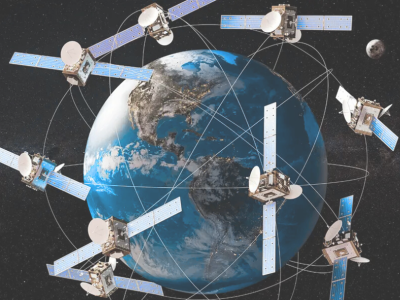
GNSS for autonomous vehicles is a key technology that enables safe and accurate navigation. These satellite systems give real-time information about a car’s location, speed, and movement, so self-driving vehicles can stay on course, avoid accidents, and make smarter decisions on the road. Today’s autonomous cars often use several satellite systems like GPS, Galileo, GLONASS, and BeiDou, and they rely on multiple signal frequencies to improve accuracy. By combining these technologies, vehicles can navigate reliably, make fewer errors, and move smoothly whether they’re driving through busy city streets or open highways.

Why GNSS Matters in Autonomous Vehicles
GNSS makes self-driving cars well-coordinated and predictable since it is more dependable than GPS itself. With a few satellites and frequencies of signals, vehicles are able to maintain a precise position even in the city where tall buildings or other amenities may occur in the way of the signal. GNSS is used in collaboration with such sensors as LiDAR and cameras. Even as such sensors scan the surroundings around the car, GNSS offers an international reference to get the car on the correct road. This collaboration is particularly significant in Level 2 to Level 4 autonomous vehicles, in which even minor positioning mistakes can impact the safety and control.
Common GNSS Failures and Challenges
Environmental Barriers
Environmental barriers like tall structures, tunnels and thick trees may block or attenuate signals.
Multipath Effects
Multipath effects are caused by the reflection of the signals off surfaces and occur as position errors.
Intentional Interference
Intentional interference such as jamming or spoofing is also susceptible to GNSS and this can deceive the vehicle into thinking it is in the wrong position.
At times when GNSS signals are untrustworthy, autonomous vehicles employ sensor fusion, which is an amalgamation of GNSS and LiDAR, cameras, and inertial measurement units (IMUs).
Autonomous vehicles employ sensor fusion with GNSS and LiDAR, cameras, and inertial measurement units (IMUs) when GPS signals are unavailable. This will make sure that the vehicles keep on navigating safely even when the satellite signals are weak or unavailable.
Techniques to Improve GNSS Accuracy
Improving GNSS for autonomous vehicles requires advanced correction techniques and multi-layered positioning strategies.To achieve precise navigation, autonomous vehicles use several strategies. RTK and PPP corrections provide centimeter-level accuracy, with RTK using local reference stations for real-time updates and PPP correcting satellite orbits and clock data globally. Combining them as PPP-RTK delivers the highest precision.
Using multiple constellations and multiple frequencies increases satellite visibility and reduces errors caused by signal blockage or interference. Cloud-based or 5G correction services offer real-time adjustments for atmospheric delays or satellite errors, ensuring high-precision positioning even in busy city environments.
Sensor Fusion for Reliability
GNSS for autonomous vehicles is subject to degradation in tunnels, urban canyons, or mountainous regions. Autonomous vehicles combine with other sensors through sensor fusion to ensure proper navigation, including:
- IMUs and inertial navigation systems: Offer short-term guidance when the GNSS signals fail.
- LiDAR and camera systems: Operate with visual-inertial or LiDAR-inertial odometry and provide supporting positioning through the analysis of the immediate surroundings.
Close systems comprising of GNSS, INS, and perception sensors ensure high accuracy even in cities or off-road conditions. By dynamically weighing the input of individual sensors, autonomous vehicles can be able to attain reliable lane-level positioning and operate safely in any condition.
Using multiple constellations and multiple frequencies increases satellite visibility and reduces errors caused by signal blockage or interference. Cloud-based or 5G correction services offer real-time adjustments for atmospheric delays or satellite errors, ensuring high-precision positioning even in busy city environments.
Urban-Specific GNSS Techniques
City driving comes with its own special navigational issues such as blocked satellites, narrow streets, and signal reflection. Some of the techniques that can be used include:
- Shadow Matching: Predicts which satellites see the city, errors in urban canyons are reduced.
- Map Matching: Compares GNSS positions with a road network to enhance accuracy.
- AI and Machine Learning Corrections: Multipath interference and blocked signal are corrected by real-time algorithms.
Sophisticated antenna designs are also used to minimize interference and stabilize GNSS signals to enhance urban navigation further.
Safety, Integrity and Regulatory Considerations
GNSS in autonomous vehicles is dependent on safety and regulatory compliance. Multi-constellation and multi-frequency GNSS is also associated with redundancy so that vehicles are free to operate safely in the event of the failure of one satellite system. Safety-of-life monitoring assesses position uncertainty and accomplishes fallback strategies where necessary. GNSS chipsets that are made of automotive grade meet the ISO 26262 and ASIL safety standards, thus making the system reliable. Starting from 2011, GNSS is also resorted to in the case of temporary system failure of LiDAR or cameras and allows safe and continuous navigation.
Future Developments in GNSS for AVs
The future of the GNSS in autonomous vehicles is high accuracy, wider coverage and smart navigation. Satellites in Low Earth Orbit will enhance coverage and minimize latency particularly on urban and remote locations. End-to-end navigation system based on machine learning applications are in progress to process GNSS and sensor information in order to provide more robust positioning. PPP-RTK technology is still in the continuously developing scope and it offers centimeter accuracy to enable credible navigation under dynamic environments.
Conclusion
GNSS for autonomous vehicles is one of the pillars of accurate and safe navigation. Multi-constellation, multi-frequency GNSS with sensor fusion, AI-driven corrections, and redundancy will enable AVs to be reliably positioned even in canyons, tunnels, or adverse terrain, which is characteristic of urban areas. Navigation performance can also be enhanced by use of urban specific strategies, advanced antennas and real time corrections. As a source of interest to all concerned about high-precision navigation, UAV or RTK GNSS systems provide insights to the high-tech real-time guidance.